.webp)


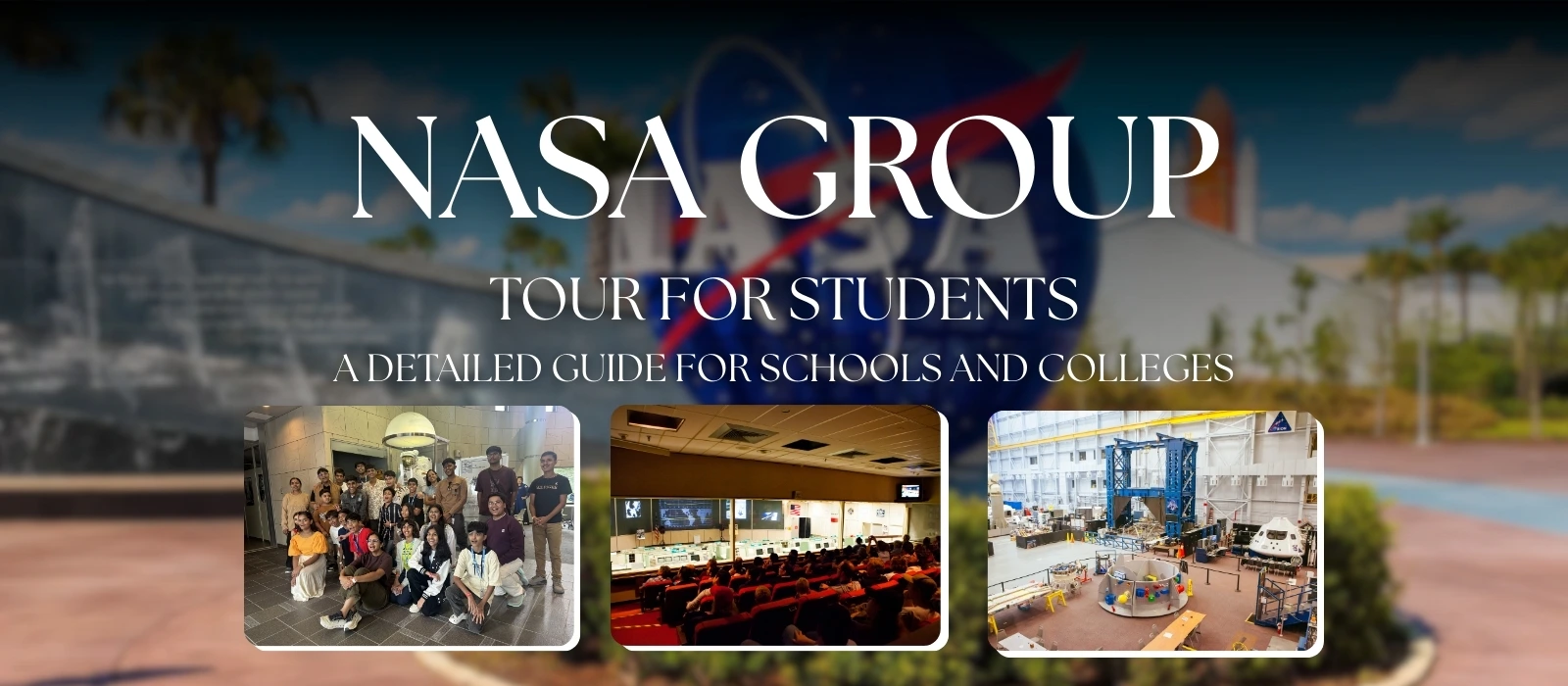
NASA Group Tour for Students: A Detailed Guide
For most students, NASA begins as a chapter in a science textbook. Rockets, astronauts, Mars missions, space shuttles everything feels distant and theoretical. But when students actually walk beneath the Saturn V rocket, sit inside astronaut training simulators, or take part in Mars exploration challenges, space science suddenly becomes real.
A NASA Group Tour is not just another international trip. It is a structured educational journey that blends STEM learning, global exposure, teamwork, and real-world observation. For schools and colleges, it offers something classrooms cannot provide: direct experience of how science, engineering, medicine, and management come together at one of the world’s most advanced space organizations.
Over the past few years, NASA educational group tours have become increasingly popular among Indian schools and colleges, especially for science students, engineering aspirants, medical learners, and even MBA programs. These tours are designed to give students exposure to large-scale research environments while also allowing them to experience American culture, museums, and innovation hubs.
This guide is written for:
- School administrators planning international study tours
- College faculty organizing technical or industrial visits
- Parents evaluating overseas educational travel
- Students preparing for NASA group tours
Instead of generic descriptions, this article explains how a real NASA group tour works — including itinerary flow, Kennedy Space Center programs, student eligibility, visa process, registration structure, safety arrangements, and learning outcomes.


Understanding What a NASA Group Tour Really Is
Many people assume that a NASA tour means entering high-security research labs or watching live rocket launches. In reality, student tours take place primarily at Kennedy Space Center Visitor Complex and associated educational facilities.
These visitor complexes are officially developed by NASA to educate the public and students through immersive experiences. While students do not enter classified research areas, they gain access to:
- Actual flown spacecraft displays
- Historic rockets like Saturn V
- Astronaut Training Experience zones
- Mars simulation labs
- Interactive STEM classrooms
- Spaceflight simulators
- Robotics and engineering challenges
A NASA group tour for students combines:
- Structured STEM education
- Experiential learning through simulations
- Exposure to real aerospace history
- Team-based problem solving
- International travel experience
Why Schools and Colleges Choose NASA Educational Group Tours
Educational institutions invest in NASA tours because they deliver outcomes that traditional classrooms struggle to achieve.
1. Applied Learning
Students see how physics, mathematics, biology, and engineering operate in real systems. Rockets are no longer diagrams they become massive structures students can walk under.
2. Career Awareness
- Aerospace engineering
- Robotics
- Biomedical research
- Space medicine
- Environmental science
- Project management
3. Skill Development
- Team collaboration
- Communication
- Analytical thinking
- Leadership
- Adaptability
4. Global Exposure
Students experience international culture, professional environments, and global standards of research.
Who Can Join a NASA Group Tour?
NASA tours are typically organized for group travel only, not individual visitors, especially when coming from overseas educational institutions.
School Students (Grades 6–12)
NASA school group tours are structured for middle and senior school students. Activities are adapted for age-appropriate learning. School tours focus on:
- Basic STEM exploration
- Curiosity building
- Team challenges
- Introductory aerospace concepts
Students participate in simulations and workshops that make science approachable and engaging.
College Students
NASA tours for college students are deeper and more technical. These programs are popular among:
- Engineering colleges
- Medical colleges
- Science departments
- Management institutions
Engineering Students
NASA industrial tours for engineering students provide insight into:
- Aerospace systems
- Robotics design
- Structural engineering
- Data-driven decision making
- Systems integration
Engineering students benefit enormously from observing how multiple disciplines work together in large missions.
Medical Students
NASA industrial tours for medical students highlight:
- Human physiology in microgravity
- Muscle and bone degeneration studies
- Psychological effects of isolation
- Telemedicine technologies
- Biomedical engineering
NASA’s research on astronauts directly contributes to medical innovations on Earth.
MBA Students
NASA industrial tours for MBA students focus on:
- Leadership models
- Operations management
- Risk analysis
- Project execution
- International collaboration
NASA is one of the largest project-driven organizations in the world, making it an excellent case study for management learners.
Structure of a Typical NASA Group Tour Package
A NASA tour package from India usually runs between 8 to 10 days, depending on the program selected. The most comprehensive option is the 9 Nights / 10 Days NASA Group Tour, which balances education with cultural exposure.
Rather than staying only in one city, students travel across multiple locations in the United States, allowing them to experience museums, historic landmarks, and innovation centers before reaching NASA.
- Arrival in New York
- Educational sightseeing in New York
- Washington DC (Air & Space Museum)
- Niagara Falls experience
- Flight to Orlando
- Theme parks for recreation and group bonding
- Two full days at Kennedy Space Center
- Return to New York
- Departure to India
This combination ensures students remain engaged while avoiding burnout from continuous technical sessions.
Why Kennedy Space Center Is the Heart of the Tour
While multiple cities are included, the core educational value comes from Kennedy Space Center (KSC) in Orlando, Florida.
Students usually spend two full days at KSC under structured visitor and STEM programs. Kennedy Space Center offers:
- Space Shuttle Atlantis exhibit
- Saturn V rocket hall
- Astronaut Training Experience (ATX)
- Mars Base simulations
- Rover robotics labs
- Botany labs
- Microgravity simulators
- Engineering design challenges
Instead of passive observation, students actively participate in problem-solving environments that mirror real aerospace scenarios.
The Role of a NASA School or College Tour Operator
A professional NASA school group tour operator manages:
- Visa documentation
- International flights
- Domestic transfers
- Hotel coordination
- Meal planning
- Site tickets
- Student supervision
- Emergency protocols
Without experienced operators, such complex tours become extremely difficult to manage. Choosing a specialized NASA student tour operator ensures smooth execution and safety.
Complete Day-by-Day NASA Group Tour Itinerary + Kennedy Space Center STEM Programs
A NASA group tour is not built around a single destination. Instead, it follows a carefully designed educational travel route that introduces students to American culture, scientific institutions, innovation centers, and finally the heart of space exploration — Kennedy Space Center.
The 9 Nights / 10 Days NASA Group Tour is structured to gradually move students from general exposure to deep technical learning. Each day serves a purpose, whether academic, cultural, or developmental.
Day 1: India to New York – Introduction to the United States
Students arrive in New York after their international flight from India. After airport pickup, the group begins their first exposure to the city through guided sightseeing.
- Statue of Liberty
- Times Square
- Fifth Avenue
- Central Park
- Rockefeller Center
- Empire State Building area
- United Nations headquarters
- Ground Zero memorial
This first day is intentionally light on technical content. It allows students to recover from jet lag while adjusting to a new country and time zone. Educational value begins here: students witness global diplomacy at the United Nations and observe urban planning in one of the world’s busiest cities.
Day 2: New York to Washington DC – Aerospace History Begins
After breakfast, the group travels by coach to Washington DC. This day introduces students to America’s scientific and political foundations.
Smithsonian National Air and Space Museum
This museum plays a critical role in preparing students for NASA. Here they explore:
- Early aviation history
- Wright brothers’ aircraft
- Apollo mission artifacts
- Satellite technology
- Space exploration timelines
For many students, this is the moment when aerospace evolution becomes tangible. Additional sightseeing includes
- White House exterior
- Capitol Hill
- Washington Monument
- Embassy Row
- FBI Building
These locations expose students to governance, international relations, and national infrastructure.
Day 3: Washington DC to Niagara – Industry and Innovation Exposure
Hershey’s Chocolate World
This is not just a fun stop. Students observe large-scale food manufacturing, supply chains, branding, and automation especially useful for MBA and management students.
Corning Museum of Glass
One of the world’s largest glass museums, Corning introduces students to:
- Advanced material science
- Glass engineering
- Live glassblowing demonstrations
- Industrial design principles
Engineering students particularly benefit from understanding how materials are tested, shaped, and commercialized.
Day 4: Niagara Falls – Natural Engineering + Return to Washington DC
Students experience Niagara Falls through the famous Maid of the Mist boat ride, which brings them close to the waterfalls. This is not merely sightseeing. Educators often use this moment to discuss:
- Hydropower generation
- Geological formations
- Environmental sustainability
- Cross-border water management
Day 5: Washington DC to Orlando – Transition to Space Education
Day 5 marks the transition from general education to focused space learning. Students fly domestically from Washington DC to Orlando, Florida. Upon arrival, the group visits Universal Studios Theme Park. While recreational, Universal Studios supports:
- Team bonding
- Stress relief
- Group interaction
Theme parks also demonstrate large-scale operations management, logistics, crowd control, and safety engineering especially valuable for MBA students.
Day 6: Disney’s Animal Kingdom – Environmental and Biological Learning
Day 6 is spent at Disney’s Animal Kingdom, the world’s largest zoological theme park.
- Environmental awareness
- Wildlife conservation education
- Ecosystem understanding
Medical and life science students gain insight into biodiversity, animal physiology, and conservation biology.
Day 7: Kennedy Space Center – Day One (Core Educational Experience Begins)
Day 7 is where the NASA journey truly starts. Students are transported to Kennedy Space Center Visitor Complex for a full day of structured educational experiences. Major highlights include:
Space Shuttle Atlantis Exhibit
- Shuttle design
- Mission objectives
- Re-entry systems
- Astronaut working conditions
Saturn V Rocket Hall
Standing under the Saturn V the largest rocket ever flown gives students perspective on scale, engineering complexity, and teamwork required for lunar missions.
Shuttle Launch Experience
A simulator that recreates the sensation of liftoff, helping students understand launch dynamics and acceleration forces.
Interactive STEM Exhibits
- Orbital mechanics
- Satellite tracking
- Space navigation
Day 8: Kennedy Space Center – Day Two (STEM Camps and Simulations)
The second day at Kennedy Space Center is more technical and participatory. Students take part in structured programs including:
Astronaut Training Experience (ATX)
- Docking procedures
- Spacewalk preparation
- Mission coordination
Mars Base Simulation
- Solve emergency situations
- Manage limited resources
- Work collaboratively
- Plan survival strategies
Microgravity Simulator
Learners experience a frictionless environment, simulating spacewalk conditions and learning how astronauts operate in microgravity.
Mars Rover Robotics
Students program and control robotic rovers, optimizing power usage and navigation. Engineering students gain exposure to robotics logic, while others understand automation basics.
Botany Lab
Students participate in plant growth experiments, learning how crops can be cultivated in space environments. Data collected is shared with NASA scientists. This directly connects space research with Earth agriculture and sustainability.
Engineering Design Challenges
Students build and test models based on age group, encouraging creativity and applied physics. These programs are not passive shows. Students actively engage, analyze problems, and work in teams.
Day 9: Orlando to New York – Reflection and Leisure
The afternoon is reserved for shopping and leisure. This provides time for reflection and informal group discussions about learning experiences.
Day 10: Return to India
After breakfast, students are dropped at New York airport for departure to India. The journey concludes but the educational impact continues long after.
Registration Process, Visa Flow, Cost Structure, Safety Measures, FAQs & Final Conclusion
Planning a NASA group tour involves much more than booking flights and hotels. Because this is an international educational journey for students, the process includes formal registration, visa documentation, financial structuring, safety planning, and institutional coordination.
Understanding these steps clearly helps schools, colleges, parents, and students avoid confusion later.
Registration Process for NASA Group Tours
Before any visa application begins, students must complete tour registration with the selected NASA school or college tour operator.
Registration typically includes:
- Submission of passport copies
- Student ID or bonafide certificate from school/college
- Completed registration form
- Initial registration payment
This registration amount covers:
- Visa processing preparation
- Early biometric appointment scheduling
- One-night hotel accommodation during biometric day
- Administrative documentation
Minimum Group Size and Teacher Participation
NASA group tours operate on group economics.
- Minimum 20 paying students are required
- If numbers fall below this, per-student cost increases
- One teacher is provided free (FOC) for every 15 paying students
Teachers play a vital supervisory role and travel with students throughout the tour. This structure ensures academic oversight and discipline during international travel.
Accommodation and Hotel Structure
Hotels are selected based on location, safety, and student suitability rather than luxury.
Exact properties may vary depending on availability, but equivalent category hotels are always provided. Rooms are shared (quad, triple, or double) based on student allocation.
Meals During the Tour
Meals are pre-planned to suit student groups and dietary preferences as much as possible.
- Daily breakfast
- Lunch
- Dinner
What Is Included in the NASA Tour Package
- International flights (India to USA and return)
- Domestic flights within USA as per itinerary
- USA visa charges and processing
- Group travel insurance
- Hotel accommodation
- All meals (breakfast, lunch, dinner)
- Kennedy Space Center two-day visitor pass
- Entry fees for listed attractions
- Professional tour manager in USA
- Sightseeing transportation by AC coaches or vans
Safety Measures During NASA Group Tours
- Group travel insurance
- Dedicated tour managers
- Private coaches for transfers
- Fixed daily schedules
- Emergency contact systems
- Medical assistance coordination
- Teacher supervision
Students remain with the group at all times. Headcounts are conducted regularly, and strict discipline is maintained during sightseeing. Before departure, students attend orientation sessions covering:
- International travel behavior
- Cultural expectations
- Emergency protocols
- Group discipline
Why Edutour Is a Trusted NASA School & College Tour Partner
Edutour is trusted by schools and colleges because it approaches NASA educational tours with a clear academic mindset. Instead of focusing only on travel, Edutour prioritizes student learning, safety, and realistic expectations. Their experience with school and college groups allows institutions to plan international educational exposure confidently, knowing that both academic value and student well-being are handled responsibly throughout the journey.
Key Reasons Schools & Colleges Trust Edutour
- Education-first planning, not tourism-focused programs
- Experience handling school, college, and professional student groups
- Clear communication of learning outcomes and tour scope
- Strong focus on student safety, supervision, and coordination
- Transparent guidance for institutions and parents
Final Thoughts for Schools and Colleges
A NASA Group Tour is not something institutions should plan casually. It requires clear objectives, responsible planning, and the right partners. When done properly, it becomes a powerful learning experience that students remember for life.
For schools and colleges that believe in holistic education, NASA educational group tours offer a rare opportunity to combine knowledge, inspiration, and global exposure. The key is to approach the tour as an educational journey, not just an international trip.
With thoughtful planning and informed decision-making, a NASA group tour for students can become one of the most meaningful academic experiences an institution offers.
FAQ's
1. What is a NASA Group Tour for students?
A NASA Group Tour is an educational travel program designed for school and college students. It focuses on learning through space centers, research exhibits, interactive experiences, and science-based exploration, helping students understand real-world applications of STEM subjects.
2. Who can participate in a NASA School Group Tour?
A NASA School Group Tour is suitable for students from upper primary to senior secondary levels. These tours are structured to match student age and understanding, making complex space science concepts simple, visual, and engaging for young learners.
3. Is a NASA Group Tour suitable for college students?
Yes, a NASA College Group Tour is ideal for undergraduate and postgraduate students. It provides deeper exposure to research, technology, innovation, and interdisciplinary learning, making it especially valuable for science, engineering, medical, and management students.
4. What do students learn during a NASA Space Center Tour?
During a NASA Space Center Tour, students learn about space missions, research processes, spacecraft systems, astronaut preparation, and Earth science applications. The focus is on understanding how scientific theories are applied in real research and exploration environments.
5. How is a NASA Industrial Tour useful for engineering students?
A NASA Industrial Tour for engineering students helps them understand systems engineering, robotics, materials science, and problem-solving at scale. It connects classroom concepts with real engineering challenges used in space exploration and advanced research projects.
6. Do medical students benefit from NASA educational group tours?
Yes, medical students benefit from NASA educational group tours by learning about space medicine, human physiology in microgravity, bone and muscle research, and biomedical technologies developed for astronaut health and Earth-based medical advancements.
7. Are NASA Group Tours only educational, or do they include other experiences?
NASA Group Tours are primarily educational but often include cultural and recreational exposure to maintain student engagement. The key focus remains learning, while balanced experiences help students stay motivated and absorb information more effectively during the tour.
